ICE Said It Would Handle Shootings by Its Own Agents. MPD Held the Perimeters and Helped ICE Leave the Scene.
20 minutes after ICE shot and killed Renee Good, they told MPD to "hold the perimeter" of their crime scene. ICE told MPD it would "handle" the ICE agent's shooting and gather the evidence. MPD held the perimeter and let ICE and critical evidence leave. And they did it again. And again.
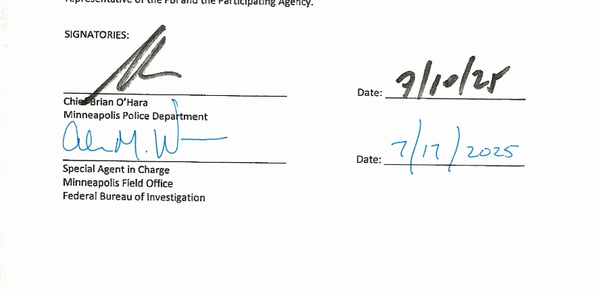
The first story in this series looked at the federal task-force agreements O’Hara signed under Frey’s command, and how Minneapolis officers, records, evidence, overtime, and disclosure decisions were pulled deeper into federal-enforcement systems.
This story uses those same public records to examine what MPD did when federal agents shot Julio Sosa-Celis and killed Renee Good and Alex Pretti. In each case, MPD was not separate from the scene. MPD helped control it by holding or managing the perimeter for ICE. Federal agencies then asserted control over the evidence and investigations. And the records reviewed do not show a clear MPD command system for protecting Minnesota’s independent authority to investigate what federal agents had done.
On the morning Renee Good was fatally shot by an ICE agent, the failure was not that MPD did not show up quickly enough. It was what happened when they did.
At 9:39 a.m. on Jan. 7, callers reported that an ICE agent had shot someone in a car near 34th and Portland.
MPD’s CAD log — the real-time dispatch record that tracks 911 calls, unit movements, officer and command updates, Fire/EMS coordination, and operational notes as an incident unfolds — recorded the first details in fragments: “ICE fired shots into a car.” “15 or more agents on scene.” “Driver was hit.” “This is shoot.”
By about 9:42 a.m., EMS was there. By 9:47 a.m., the CAD/dispatch record shows MPD on the scene calling for crowd control and blocking off streets, noting that the “crowd was getting hostile.”
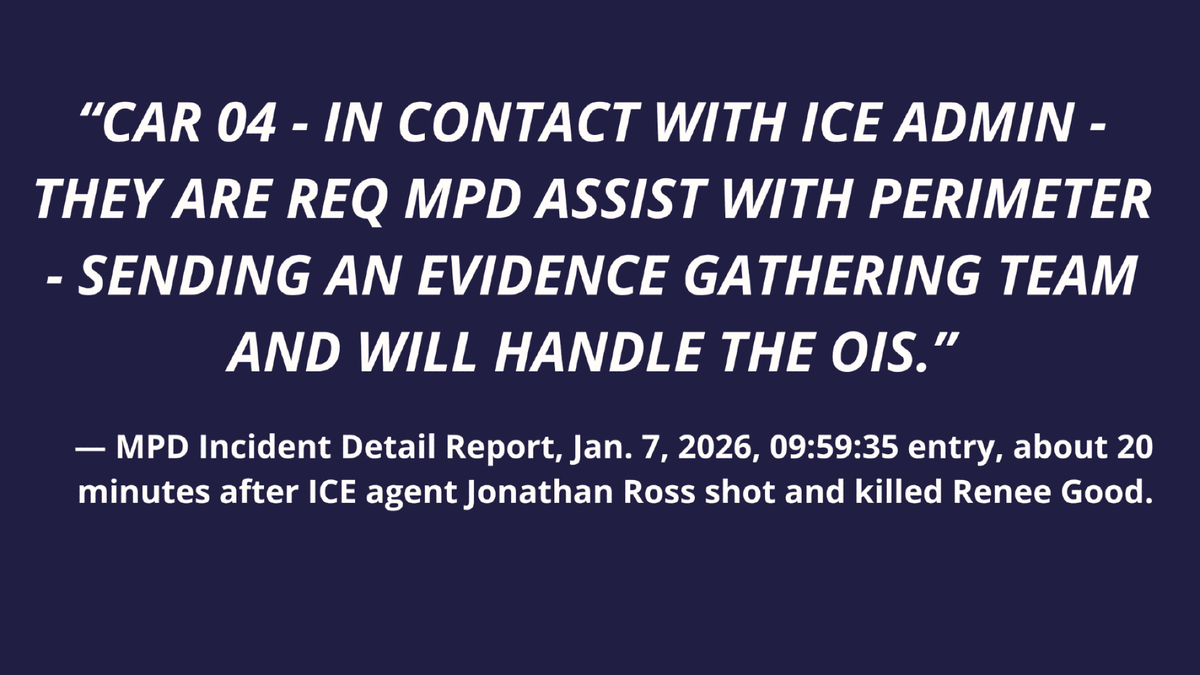
Then, at 9:59 a.m., 20 minutes after the 911 call, the CAD log recorded the line that should have changed everything:
“CAR 04 - IN CONTACT WITH ICE ADMIN - THEY ARE REQ MPD ASSIST WITH PERIMETER - SENDING AN EVIDENCE GATHERING TEAM AND WILL HANDLE THE OIS.”
In plain terms: ICE wanted MPD to control the perimeter of the scene of its OIS (officer-involved shooting). ICE was also claiming control over the evidence-gathering and investigation of its own agent’s shooting.
That was the moment MPD’s local duty should have become unmistakable. The agency whose officer fired the shots that fatally wounded a Minneapolis resident was saying it would send its own evidence team, while asking Minneapolis police to secure the perimeter around it.
MPD’s own Police Authority in Immigration Matters special order should have made that moment a command emergency. That order, issued on December 18th by then-Chief Brian O’Hara, said MPD members could operate only under MPD leadership and that “absolutely no orders, guidance, or tasks from any outside agency or person shall be followed by Department personnel unless explicitly validated and authorized through the MPD chain of command.”
The shooting also implicated Minnesota’s independent accountability infrastructure: Minnesota Bureau of Criminal Apprehension (BCA) use-of-force review, Hennepin County prosecutorial-review interests, MPD command and scene-security duties, local evidence-preservation obligations, body-camera and records-retention rules, and Minnesota Government Data Practices Act requirements.
That does not mean federal agencies lacked authority to preserve their own materials, access federal evidence, or pursue their own investigation. It means that a fatal shooting by a federal agent inside Minneapolis also implicated local and state duties that exist independently of federal control.
MPD’s job was not simply to assist ICE with a perimeter. It was to preserve what MPD had the duty to control, including evidence, scene observations, local records, officer actions, witness contacts, body-camera footage, dispatch records, radio traffic, and documentation of any federal refusal that could limit Minnesota’s independent review.
At 10:04 a.m., five minutes after ICE said it would handle the officer-involved shooting, the CAD log recorded that the agent who fired was already gone from the scene and had been transported to the federal building. MPD was still trying to determine what federal authority was in charge.
At 10:09 a.m., Car 01 directed MPD to contact whoever was in charge of the federal agents and have them leave the scene. At 10:12 a.m., Car 92 recorded that MPD would hold the scene and needed ICE agents evacuated “when safe and as fast as poss.”
At 10:26 a.m., Car 92 directed officers to clear a corridor on Portland so ICE could leave and to fill perimeter gaps once ICE was gone.
Those entries show MPD was present, active, and giving commands. But the CAD record shows those commands protected the perimeter and ICE’s exit more clearly than they protected the evidence path Minnesota needed for independent review.
Records show the FBI entering the crime scene at 11:31 a.m. The Minnesota BCA did not enter the crime scene until 12:13 p.m. By then, critical evidence had already been removed by federal authorities.
Mayor Jacob Frey and then-Chief O’Hara publicly framed the immediate aftermath of the fatal shooting as a crisis of federal transparency, protest response, public safety, and local limits over ICE. They did not treat it as an MPD command failure requiring immediate review, a federal-shooting protocol, or clear rules to protect Minnesota’s independent investigative authority.
That command failure, and MPD’s lack of any clear system for asserting local authority, left federal agents to define the terms of what happened next.
O’Hara Said the Fatal Federal Shooting Was “Entirely Predictable.” MPD Still Had No Clear Protocol When Federal Agents Shot Again. And Again.
The day after Renee Good was killed, then-Chief Brian O’Hara told CBS News the fatal federal shooting was “entirely predictable.”
“We recognize quite obviously that this has been building over the course of several weeks,” O’Hara said.
By then, MPD had more than a public warning. It had a documented operational problem: Federal agents could shoot and kill someone in Minneapolis; claim control over the crime scene and the investigation; remove their personnel and evidence from the crime scene; and leave Minnesota’s independent accountability system dependent on federal cooperation.
One week later, the Jan. 14 logs show that warning had not been translated into clear command control.
At 7:14 p.m. on Jan. 14, about 25 minutes after ICE shot Julio Sosa-Celis in North Minneapolis, the MPD log recorded:
“ONLY HOLDING PERIMETER - ICE IS HANDLING AND RESOURCES ARE ENROUT.”
By 8:11 p.m., the log described the case as a “FEDERAL INVESTIGATION OIS” and recorded that BCA requested MPD/MPS to hold the scene. By 8:12 p.m., officers were being asked to remain on scene for BCA.
That shows BCA entered the accountability sequence. But the public records reviewed do not show who first notified BCA, when BCA was first notified, what MPD did before BCA entered the scene, or whether Minnesota’s independent authority was protected from the start.
Later entries show federal agents remained embedded in the scene for hours. At 9:37 p.m., the log said: “REPLACE ANY ICE AGENTS ON PERIMETER.” At 9:49 p.m., it said: “FEDS WILL REMAIN.” At 10:04 p.m., ICE was only then attempting to leave.
The problem was not only that federal agents had asserted control. The records show MPD was managing the scene around that control: Holding the perimeter while ICE was "handling" the OIS of its own agents; replacing ICE agents on the perimeter; and maintaining officers on scene while federal agents remained.
Ten days later, federal agents shot and killed Alex Pretti near 26th and Nicollet. This time, the jurisdictional conflict appeared in the records almost immediately.
At 9:03 a.m. on January 24, callers reported that ICE had shot someone near 26th and Nicollet and that there had been “at least 4 shots.” By 9:10 a.m., MPD was putting up tape. By 9:12 a.m., officers were expanding the perimeter because of a large crowd. By 9:18 a.m., Car 01 recorded that BCA had been advised and was responding.
At 9:24:18 a.m., the CAD log recorded the conflict directly:
“09 INFO – FEDERAL AGENTS ON SCENE ASKING MPD TO LEAVE CRIME SCENE —PER CAR 01 MPD HOLD CRIME SCENE.”
The Watch Commander log later described the same incident in command terms. In the 9:03 a.m. to 10:32 a.m. entry, Watch Command described a “26th/Nicollet ICE OIS” and wrote:
“Federal agent OIS, responded to crime scene. Navigated jurisdictional issues, ultimately working to get MPD squads out of the crime scene and to the edge of the perimeter.”
The December 18th special order had already made Watch Command the control point for federal immigration-enforcement response, outside-agency contact, command validation, Chief notification, and documentation. But the records reviewed do not show a complete public protocol or audit trail explaining how MPD would preserve state and local authority when federal agents asserted control over a fatal scene.
This was not only an administrative gap. It left no clear, enforceable command protocol for protecting evidence and independent investigations after federal agents shot Julio Sosa-Celis and killed Renee Good and Alex Pretti.
In late March, Hennepin County, the State of Minnesota, and the BCA sued the Department of Justice and the Department of Homeland Security for access to evidence in the federal shootings of Renee Good, Julio Sosa-Celis, and Alex Pretti. Hennepin County said federal agencies were withholding evidence needed for state and county review.
After Good was killed, BCA initially expected to investigate with the FBI, but federal officials shifted to an FBI-only investigation. State officials said BCA was left without access to evidence, interviews, case materials, and Good’s vehicle itself.
Federal Jurisdiction Did Not Erase MPD’s Independent Duties
Federal agencies may have claimed authority over their own personnel, evidence, and investigations. But several independent rules still governed what Minneapolis police had to preserve, document, and command when MPD officers were used at federal shooting scenes.
1. Minnesota’s BCA independent use-of-force investigation law
Minnesota law creates an independent Use of Force Investigations Unit within the Bureau of Criminal Apprehension (BCA) to conduct officer-involved death investigations. The law gives Minnesota its own independent investigative authority for officer-involved deaths. State law also requires law-enforcement agencies to cooperate with BCA investigations.
That statutory framework does not mean MPD controlled federal agents or federal evidence. It means Minnesota has its own public-accountability structure for deaths and harm caused by law-enforcement force, and local agencies have duties within that structure.
2. Hennepin County’s officer-involved shooting protocol
Hennepin County’s OIS protocol describes the protocols necessary for independent review: Early contact with the Hennepin County Attorney's Office; investigation by an agency other than the officer’s employing agency; documented briefings, public-safety statements, officer and witness statements; preservation of uniforms, weapons, body-worn cameras, and video; 911 calls, dispatch records, ambulance reports, crime-scene logs, and immediate evidence inventories.
Independent review depends on the earliest evidence-control standards: who was there, who fired, who witnessed it, what was moved, what was recorded, who was interviewed, what evidence was logged, and who had access.
If ICE claimed control while MPD held the perimeter, the county and state review process could be compromised before it began. The later federal evidence lawsuit shows how that risk became a reality.
3. MPD’s December 18 "Police Authority in Immigration Matters" Special Order
MPD’s special order made outside-agency direction or guidance subject to MPD chain-of-command review, authorization, and documentation. The order said MPD members could operate only under MPD leadership and could not follow outside-agency “orders, guidance, or tasks” unless those directions were validated and authorized through MPD chain of command.
The order also routed federal immigration-enforcement questions through Watch Command for officer guidance, Chief notification, and required documentation.
That made the January shooting scenes matters of MPD command and control, not just perimeter assignments.
Once MPD officers were helping hold or manage the perimeter for ICE, the question was no longer only where officers stood. It was who directed them, what authority they were operating under, what they were told to preserve, what they documented, and who protected Minnesota’s independent authority to investigate federal use of force.
The public records reviewed for this story do not show a complete command record explaining how MPD validated, limited, rejected, or escalated those federal requests while protecting BCA access, Hennepin County review, local records, witness access, and documentation of federal refusals.
4. MPD policy and mayoral command authority
MPD employees are bound by department policies, procedures, orders, ordinances, and applicable law. The Minneapolis Charter also gives the mayor “complete power” over the establishment, maintenance, and command of MPD.
That means local responsibility did not disappear when federal agents claimed control. After Renee Good was killed, Frey and O’Hara could have required a clear and public federal-shooting protocol for MPD.
That protocol should have addressed what January 7 exposed: Who controls the crime scene, who notifies BCA and Hennepin County, who preserves MPD body-camera footage and dispatch records, who documents federal refusals or restrictions, who decides when MPD officers shift from scene control to perimeter support, and who ensures Minneapolis police do not help the federal agency whose agents shot and killed people in Minneapolis control the evidence, witnesses, and records needed for independent investigation, prosecutorial review, and public accountability.
The Federal Case Continues. Frey Still Owes Minneapolis Answers.
The federal evidence case is still moving. DOJ and DHS were ordered to give final written responses to Minnesota’s evidence demands by June 4. Late Friday, June 5, Hennepin County Attorney Mary Moriarty announced the federal government still refuses to turn over evidence related to the killings of Renee Good and Alex Pretti and the shooting of Julio Sosa-Celis. Hennepin County and the State are scheduled to amend their lawsuit on June 18, with motions scheduled to follow on June 25.
But Minneapolis should not need a federal judge to answer MPD’s part of this. Frey still owes the public an accounting of who was in command, what MPD did to protect evidence and witnesses, what happened to dispatch records and body-camera footage, how BCA access was protected or lost, and who decided when Minneapolis officers would hold a scene, leave a scene, or move to the edge of a federal perimeter. Most of all, he needs to explain what enforceable rules now prevent MPD from becoming merely a perimeter force for federal violence the next time it happens.

Public records are not accountability unless people can use them to challenge power, demand answers and change, and hold public officials responsible for what the records show.
I am doing this work as a labor of love and a deep commitment to public accountability, collective care, and systems designed by, governed by, and accountable to the multiracial communities whose lives they shape.
My goal is to be accountable to the same standards of integrity, truth, care, and justice this work demands from public systems.
Want to get involved? Reach out to me with ideas, questions, documents, leads, corrections, or anything you think needs closer review!
And let me know if you want to help with records requests, fact-checking, legal or policy research, data review, coding, synthesis, timeline-building, analysis, or other work that helps make public records usable for transparency and accountability.
Hope to see you around Minneapolis soon, comrades!