How Frey and O'Hara Failed Minneapolis During Operation Metro Surge
Federal enforcement brought fear and violence into Minneapolis. Records show MPD moving deeper into that machinery under Frey’s command while urgent calls waited, command rules blurred, and federal systems further obscured MPD’s duty, decisions, and accountability to the public.
Public records show MPD moved deeper into a shifting federal infrastructure under Frey’s command while urgent calls were delayed, command rules were unresolved, and Minneapolis faced one of the most serious civil-liberties crises since George Floyd’s murder.
Mayor Jacob Frey and then-MPD Chief Brian O’Hara did not lack warning.
By summer 2025, the risks to Minneapolis public safety were visible both inside MPD and in federal enforcement rhetoric and operations across the country.
MPD was already operating under court-enforceable civil-rights reform obligations, claiming severe staffing strain, and relying heavily on record overtime.
At the same time, the Trump administration was building a militarized federal enforcement campaign that was turning immigration enforcement, protest response, local records, and public-safety authority into civil-rights and local-governance flashpoints in cities such as Los Angeles, Chicago, Portland, and Nashville.
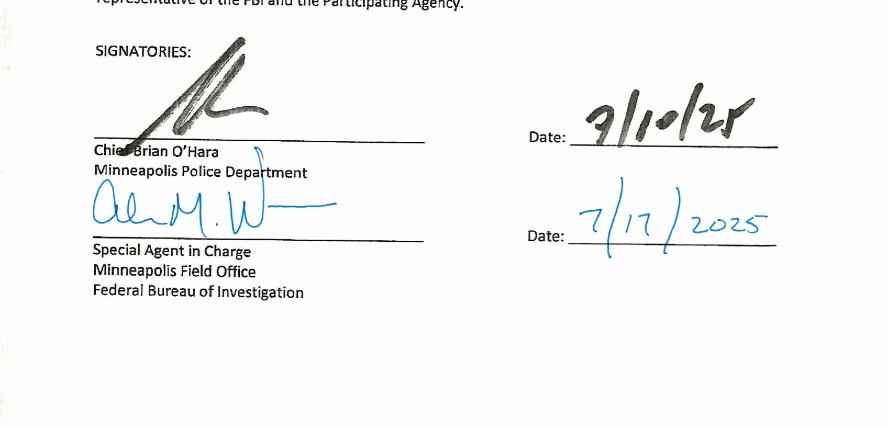
Yet during that same time period, O’Hara signed new federal task-force agreements that place MPD deeper inside FBI-controlled policing systems—where federal officials can deputize local officers, direct investigations, control information, and draw Minneapolis police capacity toward the shifting federal priorities of Trump and his Department of Justice.
The timing matters.
O’Hara signed the 2025 Joint Terrorism Task Force agreement on July 10, 2025, about five weeks after the June 3 Lake Street federal show of force involving heavily armed federal agents in tactical gear, armored vehicles, MPD officers alongside federal agents, pepper spray, protesters being placed in flex cuffs, and a protester later charged in a contested federal case.
MPD entered the 2025–26 Homeland Security Task Force reimbursement agreement on December 15, 2025, about two weeks after federal agents were already occupying the Twin Cities under Operation Metro Surge.
(See more below on still-active agreements.)
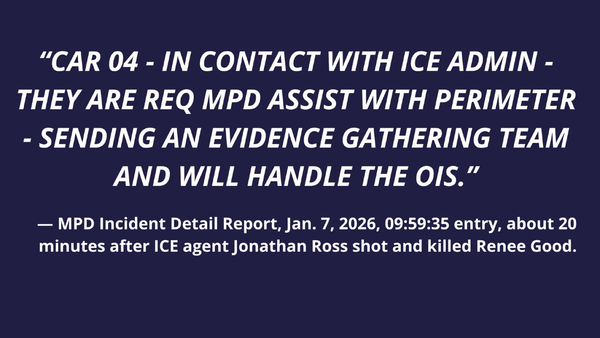
Three days later, on December 18, O’Hara issued a special order that made Watch Command the "sole point of contact" for managing and coordinating MPD’s response to city-wide issues related Operation Metro Surge.
Yet on January 7, the morning ICE agent Jonathan Ross shot and killed Renee Good in South Minneapolis, email records show O’Hara was still asking for the updated Watch Commander policy and standard operating procedure for the very command role he had made responsible for guiding MPD’s federal-enforcement response.
The consequences of both Frey and O'Hara's lack of control of an increasingly federalized police department were immediate and ongoing.
Records show MPD left urgent emergency calls waiting more than an hour; operated without clear local command limits over its federal role; relied on an unresolved command system during Metro Surge; allowed local protest activity to move through federal intelligence channels; and entered agreements that placed officer time, records, intelligence, evidence, body-camera footage, disclosure decisions, workload tracking, and overtime capacity inside federal systems.
The records reviewed and analyzed for this story do not show MPD violated the city's separation ordinance, established December 11, 2025, which prohibits MPD from investigating, supporting, or assisting in immigration enforcement.
But they do prove something equally significant. They make clear that a glaring and foreseeable failure of local governance exposed Minneapolis residents to deeper harm during Metro Surge and left the city vulnerable to continued federalized policing through local task-force agreements that put residents’ rights, liberties, safety, privacy, humanity, and dignity at risk.
The central question is not simply whether MPD coordinated with ICE. It is whether Mayor Jacob Frey exercised control over the police department he alone had the charter authority to command as Minneapolis faced a violent federal enforcement threat that left two people dead, injured many others through federal use of force, and kept immigrant and refugee communities under constant threat.
Who ensured that police capacity was reserved first for urgent 911 calls, rather than diverted into federal requests, protest response, intelligence-sharing, or reimbursed task-force work?
Who ensured that MPD fulfilled its basic duty to support an independent investigation into violence committed by federal agents inside the city?
Who ensured the crime scene, local records, dispatch data, body-camera footage, physical evidence, and witness access were protected when federal agents used deadly force in Minneapolis?
Who ensured immigrant communities, protesters, legal observers, bystanders, and residents facing immediate danger weren't exposed to greater harm through the city’s own police department?
O’Hara is gone. But accountability for those decisions did not leave with him. Under Minneapolis’s strong-mayor system, Frey had command authority over the department that entered those agreements. He had the power to demand review, impose limits, require public reporting, protect local records, preserve emergency-response capacity, and pull MPD back from ambiguous federal partnerships that put the community at risk. Records do not show him doing any of those things.
Hours Before Renee Good Was Killed, O’Hara Was Still Seeking the Standard Operating Procedure for MPD’s Federal-Enforcement Command Role
Records show MPD was making life-and-death federal-enforcement response decisions through an unresolved command system O'Hara himself had been seeking a standard operating procedure for "maybe a year."
On December 18th, after Operation Metro Surge had been underway for more than two weeks, O'Hara issued MPD's immigration-enforcement special order. That order made the Watch Commander the “sole point of contact” for guidance on MPD’s response to federal immigration enforcement.
Weeks later, on January 7, 2026, at 6:42 a.m., O’Hara forwarded a “Watch Commander Nights” email from Watch Commander Lt. John Kelly to then-Assistant Chief of Operations Katie Blackwell, his chief of staff Leslie Silletti, and Deputy Chief of Patrol Mark Klukow.
In the email, O’Hara wrote that, for “months, maybe even a year,” he had been asking for an updated Watch Commander policy and Watch Commander SOP (standard operating procedure).
Roughly three hours after O'Hara sent that email, ICE agent Jonathan Ross shot and killed Renee Good in South Minneapolis.
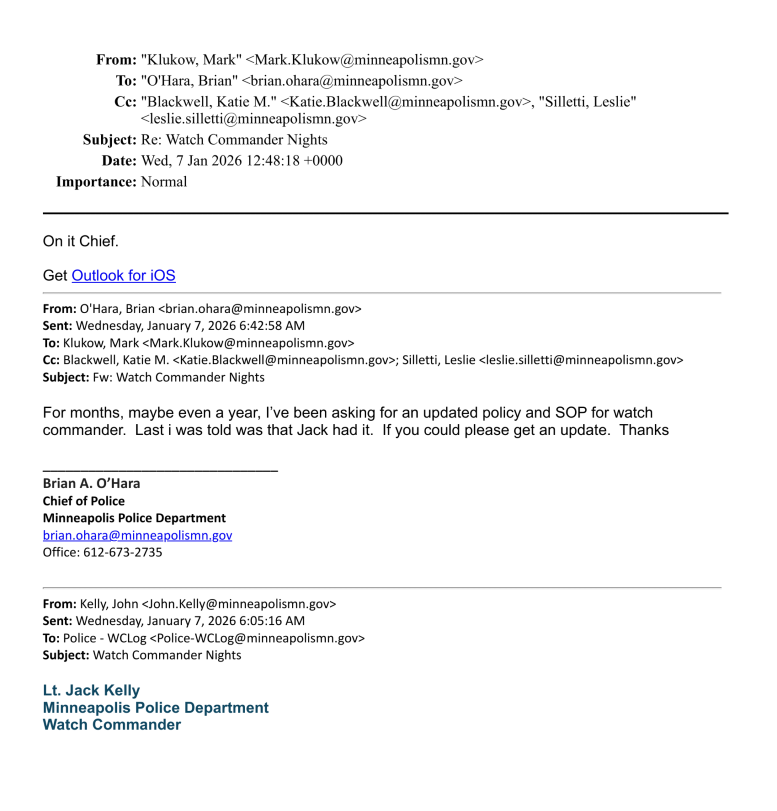
That sequence is critical: O’Hara had already made Watch Command the control point for federal immigration-enforcement response, ICE-related protests, federal help requests, officer guidance, Chief notification, and documentation. But weeks after making this special order, he was still seeking the updated SOP that should have governed that authority.
This was not a minor administrative gap. The Watch Commander is already one of MPD’s highest-stakes command roles. MPD policy describes the Watch Commander as “an extension of the Chief’s office” and the Chief’s adjutant during non-business hours, responsible for nightly supervision of MPD operations.
MPD’s own written-directives policy separately recognizes a Watch Commanders’ Manual as a required specialized procedure manual. That policy says specialized procedure manuals "must be kept current as unit procedures change, provided to the Operations Development Unit, and contain the unit’s basic operational procedures."
In other words, MPD policy required the Watch Commanders’ Manual to remain current whenever Watch Commander procedures changed.
Yet the last publicly available Watch Commander policy is dated November 2, 2016, even though the role governs citywide command, staffing adjustments, outside-agency assistance, major-event response, emergency-call limitations, misconduct response, and written daily activity reporting.
O’Hara’s statement that he had sought an updated Watch Commander SOP for "maybe a year" is significant because it shows MPD leadership knew the existing policies and procedures were outdated or inadequate.
That matters beyond Metro Surge because the Watch Commander is not only a crisis role. It is a daily accountability function.
Yet on January 7, weeks into the most serious civil-liberties and public-safety crises Minneapolis had faced since George Floyd’s murder, MPD’s federal immigration-enforcement response was running through a command role whose required updated policy and SOP didn't exist.
That missing procedure mattered immediately.
Three hours after O'Hara sent that email, the command question was no longer only how MPD should respond to ICE-related protests or federal help requests.
It was what MPD was required to do when federal agents killed someone in Minneapolis.
Who would secure the crime scene? Who would preserve local records, CAD entries, dispatch logs, officer observations, and body-camera footage? Who would protect local access to evidence and witnesses? What procedures would MPD follow to support investigations into federal shootings, deaths, and other abuses? And what would MPD do if federal agencies asserted control over the investigation?
A Minneapolis resident was dead. And MPD had no clear plan for securing the scene, protecting the evidence, or ensuring the fatal shooting could be investigated.
Within a day of Good’s killing, Minnesota’s access to the investigation had already become the crisis.
The Minnesota Bureau of Criminal Apprehension had initially been expected to investigate Good’s killing with the FBI. Then the U.S. Attorney’s Office changed course. BCA Superintendent Drew Evans said the FBI would lead the investigation alone, leaving BCA without access to the case materials, scene evidence, or investigative interviews needed for a thorough independent investigation.
In late March, the Hennepin County Attorney’s Office, the State of Minnesota, and the Minnesota Bureau of Criminal Apprehension sued the federal government for evidence related to the federal killings of Renee Good and Alex Pretti and the shooting of Julio Sosa-Celis during Operation Metro Surge. The lawsuit names the U.S. Department of Justice, Attorney General Pam Bondi, the U.S. Department of Homeland Security, and DHS Secretary Kristi Noem.
On May 7, Hennepin County Attorney Mary Moriarty announced the federal government had produced some of the evidence related to Good’s killing. But it was only after a court order in a separate federal criminal case, and not to state investigators conducting Minnesota’s own review of the fatal shooting by ICE. Moriarty there was still no guarantee Hennepin County could secure the necessary access to the required evidence to bring charges forward.
The DOJ and DHS are ordered to provide final written responses to Minnesota’s evidence demands by June 4, 2026.
Yet nearly five months after Good was killed by ICE agent Jonathan Ross, the FBI still says the investigation is “ongoing.” Ross was placed on administrative leave for only three days after he killed Good, and after video captured him shooting her in the head and calling her a “f*cking bitch” as she died.
Without a clear MPD procedure in place, Minneapolis had no local accountability system ready for the moment federal power turned lethal inside the city—and then asserted control over the scene, the evidence, and the investigation itself.
Other records show how that unresolved command policy and procedure further created chaos, fear, and vulnerability for Minneapolis residents.
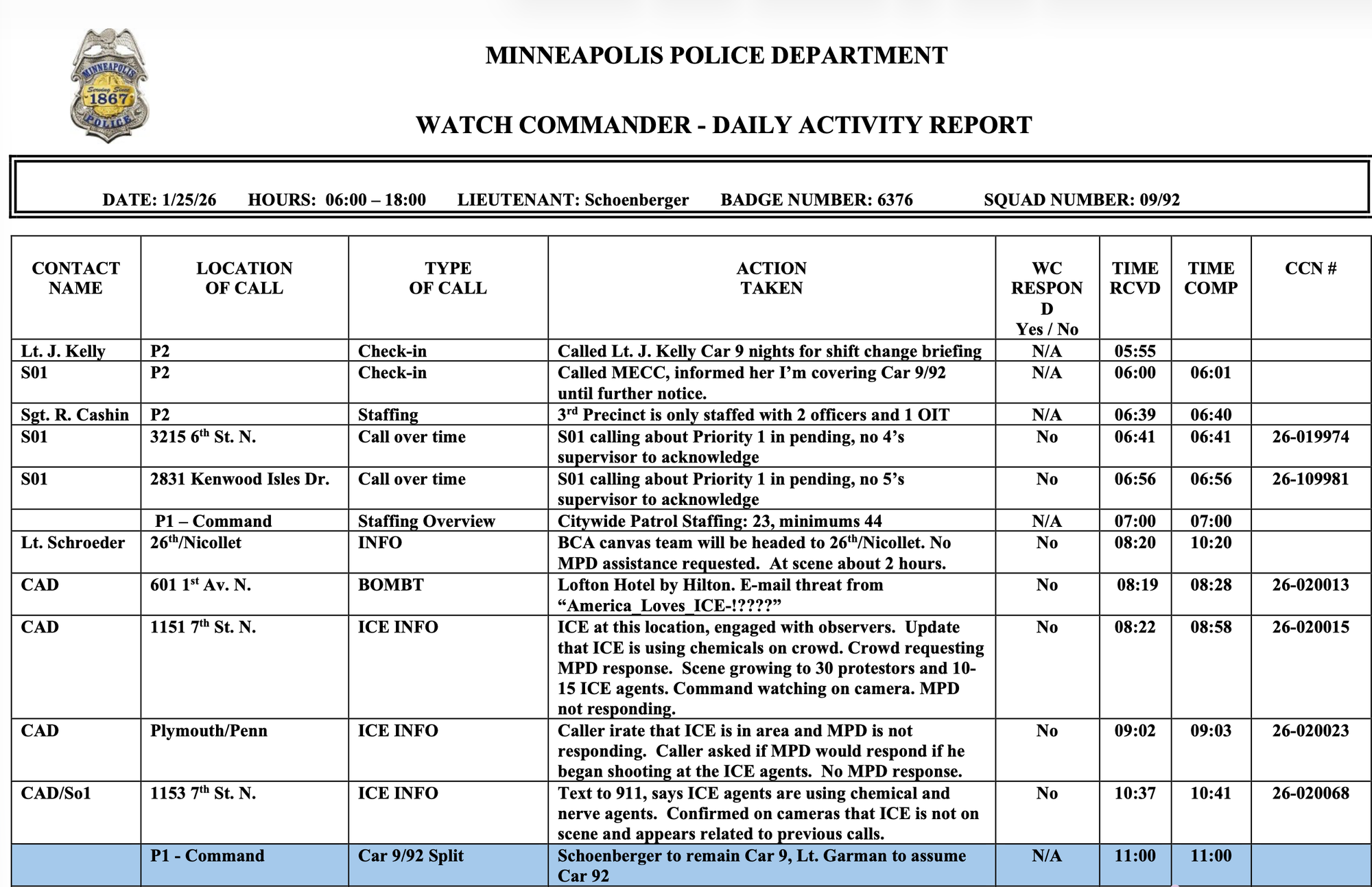
On January 25th—the day after Alex Pretti was shot and killed in Minneapolis by Border Patrol agent Jesus Ochoa and Customs and Border Protection officer Raymundo Gutierrez—the Watch Commander log recorded citywide patrol staffing at 23 officers against minimums of 44.
It also showed urgent Priority 1 calls across the city pending with no precinct supervisor available to take responsibility for any response; and a 3rd Precinct watch staffed with only two officers and one officer-in-training.
The same log recorded an ICE-related scene where ICE was reportedly “using chemicals on crowd,” a growing group of 30 protesters and 10–15 ICE agents, “Command watching on camera,” and “MPD not responding.” Another entry recorded a caller angry that ICE was in the area and MPD was not responding, asking whether MPD would respond if he began shooting at ICE agents.
This was not an unforeseen capacity issue. MPD leaders had been describing the department as short-staffed since police murdered George Floyd in 2020. By Operation Metro Surge, that was no longer a surprise condition. It was the department’s known operating reality.
That reality required stricter command rules, clearer limits on outside-agency commitments, and public reporting for how limited officers would be prioritized when federal enforcement, protest response, urgent local calls, and public fear collided inside Minneapolis.
Frey and O’Hara had months, if not years, to plan for that collision. They had a duty to protect local emergency-response capacity, limit federal and outside-agency demands, and establish clear, reviewable command rules for what MPD would do when federal enforcement activity produced protests, urgent 911 calls, federal help requests, use-of-force incidents, evidence questions, and public demands for local response.
Instead, the records reviewed so far show Watch Command trying to manage the crisis in real time: federal agents operating in the city, protesters gathering, residents demanding answers after another fatal shooting by federal agents, urgent calls waiting, precincts below minimum staffing, and escalating federal violence forcing the very questions Frey and O’Hara should have answered before the crisis began. Who was in command? Whose requests took priority? Who protected emergency response? Who preserved local records and evidence? Who ensured that MPD’s federal role did not further obscure its duty and accountability to the public?
That failure cuts directly against MPD’s court-enforceable obligations under the Minnesota Department of Human Rights agreement. MDHR opened its investigation into the City and MPD after George Floyd’s murder and found probable cause that they engaged in a pattern or practice of race discrimination in policing. The 2023 agreement, approved by the court, requires Minneapolis and MPD to make binding reforms around lawful, non-discriminatory policing, supervision, accountability, transparency, data collection, and public trust.
MPD Committed Local Capacity to Federal Priorities While Residents Facing Life-Threatening Danger Waited
The risk the the community was not only the direct harm of a federal occupation. It was also the abandonment MPD's local public-safety obligation to the community.
During Operation Metro Surge, MPD records show Minneapolis leaders made police capacity available to federally defined priorities while residents facing active emergencies—including domestic-abuse calls classified as Priority 1—were left waiting for a response for more than an hour.
MPD entered 2025 federal task-force agreements that deputized and commanded MPD officer time and capacity while already relying on record overtime spending Frey and O'Hara claimed was necessary to hold basic MPD operations together. And Minneapolis taxpayers were already paying millions for it.
Reporting shows MPD overtime rose from $22.6 million in 2023 to $27 million in 2024 and $31 million in 2025, with the department investigating possible overtime misuse. A city memo later showed MPD finished 2025 more than $21 million over budget, driven largely by a record $32.9 million in overtime spending against a $5 million overtime budget.
O’Hara’s own email records show that MPD command had daily visibility into those staffing limits. Daily staffing reports he and MPD leadership received tracked capacity by precinct and watch, including minimum staffing, total officers, supervisors, officers in training, OT/CSOT, two-person squads, desk officers, “Able,” and sick time.
These categories show that MPD was not simply counting bodies. It was tracking the operational composition of each watch: which precincts were below minimum, which shifts depended on overtime, how many officers were trainees or assigned to desks, how many were out sick, and how many two-person squads were listed.
The reports do not conclusively show how many officers were actually available to answer 911 calls at any given moment, especially because “Able” is undefined in the documents provided. But they do show that command had regular visibility into the staffing pressures, role assignments, overtime reliance, and squad configurations that should have forced daily decisions about what MPD could take on, what it had to refuse, and how it would protect residents calling for urgent help during Operation Metro Surge.
MPD records show residents facing immediate threats to life or safety were left waiting for more than an hour for MPD to respond.
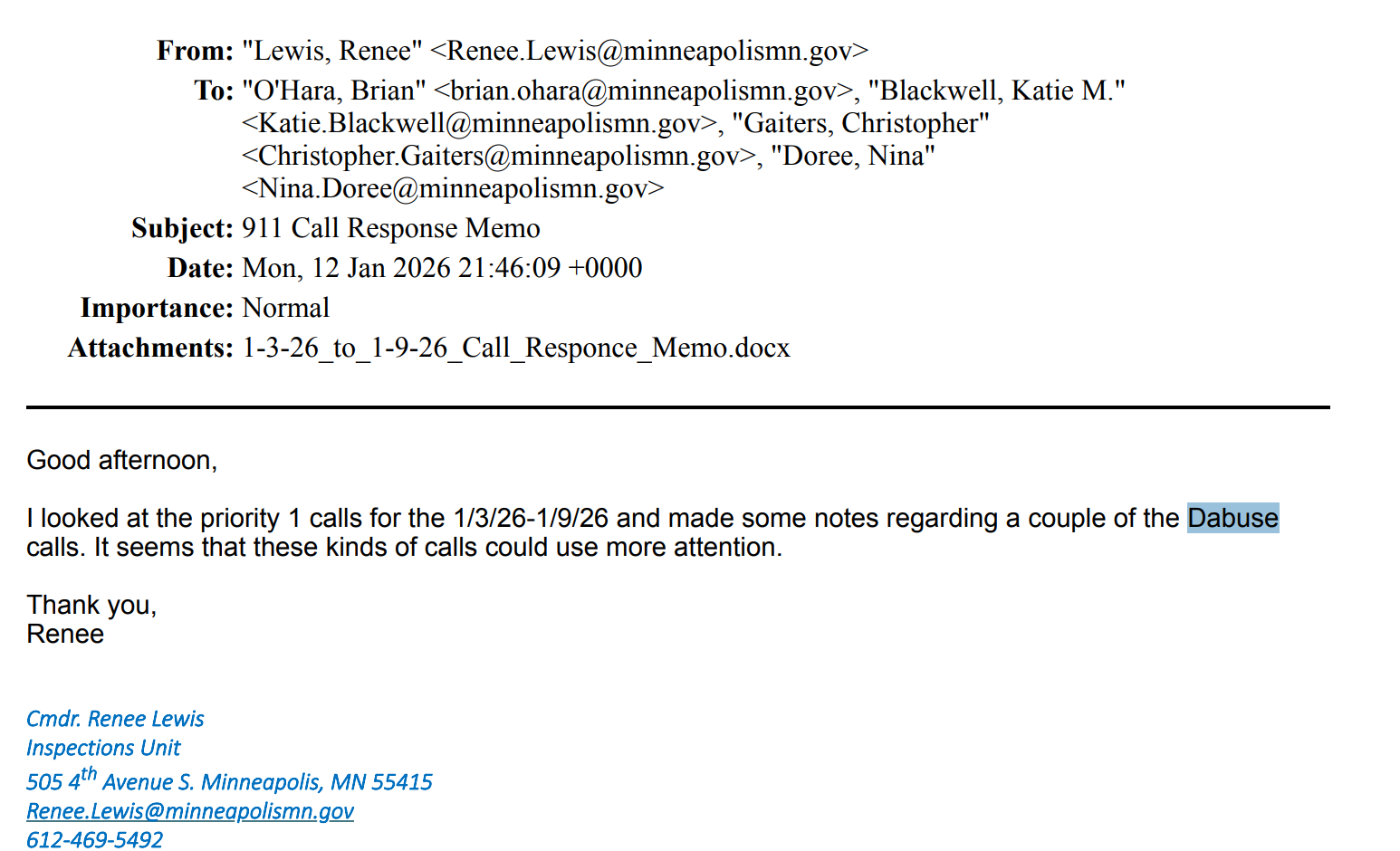
A January 12 email from Commander Renee Lewis to O’Hara, Katie Blackwell, Christopher Gaiters, and Nina Doree forwarded an MPD Call Response Policy Adherence memo reviewing Priority 1 calls pending more than 30 minutes for the week of January 3–9.
Priority 1 applies where “an imminent threat to personal safety, or the loss or damage to property exists” and “conditions at the scene of the call are unstable.”
The memo reported 14 Priority 1 calls held pending more than 30 minutes; six were domestic-abuse calls. Two domestic-abuse calls were pending for 48 minutes and 56 minutes, respectively.
In the email, Lewis wrote: “It seems that these kinds of calls could use more attention.”
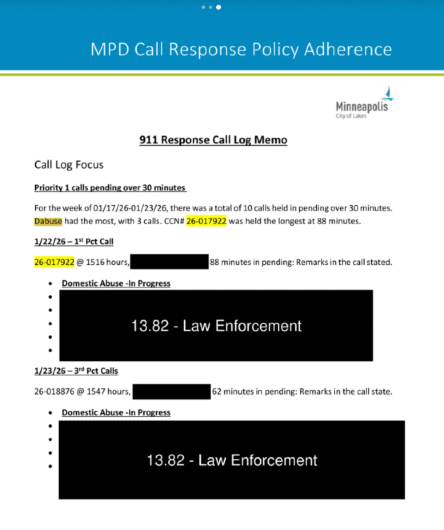
The following week showed the same breakdown in emergency-response planning and capacity. For the week of January 17–23, MPD identified 10 Priority 1 calls held pending more than 30 minutes. Domestic abuse was again the largest category, including one domestic-abuse-in-progress call held pending for 88 minutes and another held pending for 62 minutes.
Months earlier, during an MPD briefing, O'Hara was promising Priority 1 response times would be closer to seven minutes.
Minneapolis Emergency Communications Center’s own objective is faster still: to have a squad en route to a Priority 1 event within 70 seconds of the dispatcher receiving the call. Minneapolis Emergency Communications Center's objective is to have a squad en route to a Priority 1 event within 70 seconds of receipt by the dispatcher.
Yet MPD’s January records show that residents facing life-threatening emergencies were sometimes left waiting more than an hour for police response.
Those records of serious delays do not, by themselves, prove that any specific delayed emergency response was caused by MPD participation in a federal task force. But they make the leadership and public-capacity questions unavoidable.
Frey and O’Hara were not caught off guard. They knew MPD was operating inside what it long-claimed was a staffing crisis. They knew emergency-response capacity was already strained during Operation Metro Surge. And yet the records show city leaders still failed to make critical command and daily deployment decisions that put local public-safety and people calling for urgent help came first.
The January domestic-abuse delays also occurred inside an ongoing domestic-violence accountability crisis for MPD. This was not an issue O’Hara could plausibly treat these life-threatening delays as isolated or a one-off issue caused by Operation Metro Surge. After the deaths of Allison Lussier and Mariah Samuels, MPD was already facing public criticism, city audit scrutiny, and demands to reduce response times, improve follow-up, recognize escalating danger, and act on repeat calls that showed a growing risk of serious harm or death.
And yet in January, after years of warning signs and amid life-threatening delays, MPD Commander Renee Lewis was still left to put the obvious in the softest possible terms: “It seems that these kinds of calls could use more attention.”
The 2025 JTTF Agreement Expanded the Federalization of Minneapolis Policing
The 2025 Joint Terrorism Task Force (JTTF) agreement was not simply a routine renewal of a federal task-force partnership. It placed Minneapolis officers deeper inside FBI-controlled systems at a moment when federal officials were expanding the meaning of threat, obstruction, national security, and domestic terrorism.
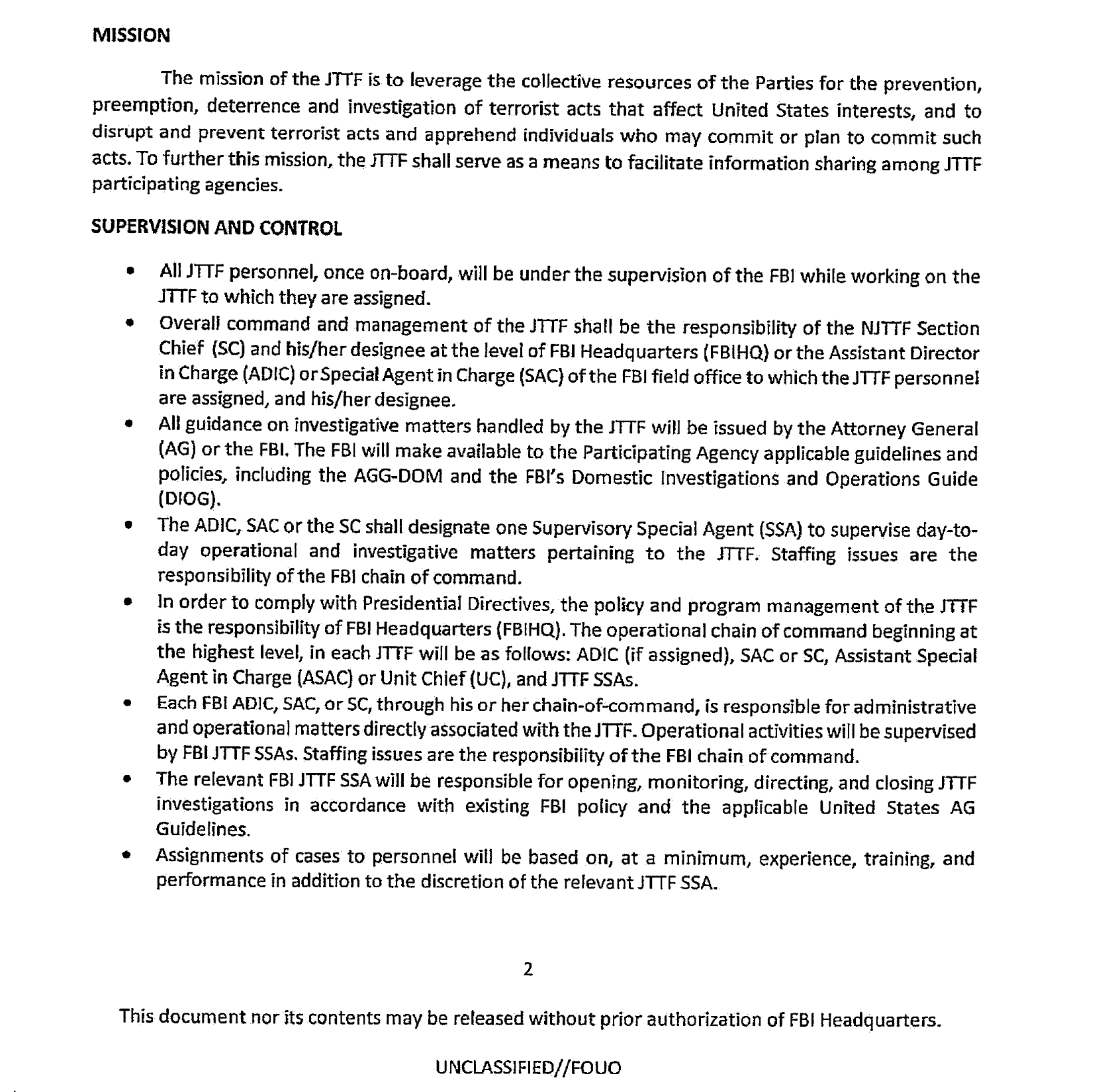
MPD’s participation in the JTTF was not new. Earlier post-9/11 agreements had already raised civil-liberties concerns by placing local officers inside federal task-force structures involving deputation, FBI supervision, secrecy provisions, and limits on public disclosure. (For comparison, I reviewed the previous 2007 Minneapolis PD–FBI JTTF MOU and the separate St. Paul Police Department–FBI JTTF MOU , signed in 2012.)
What changed in 2025 was the context and the control structure.
Federal command and deputation. Through the 2025 JTTF, Minneapolis officers can remain MPD employees, use MPD equipment, carry MPD legitimacy, and be paid by Minneapolis taxpayers while working as federally deputized task-force officers under FBI supervision. That structure blurs the line between local police authority and federal enforcement power.
Federal control over records and disclosure. The 2025 agreement says JTTF materials and investigative records "originate with, belong to, and will be maintained by the FBI." It restricts JTTF personnel from disclosing FBI- or JTTF-related information outside the FBI, including within MPD, without prior FBI approval. That means records created through Minneapolis police participation can move into a federal disclosure system that local officials, oversight bodies, courts, journalists, and residents may not be able to access through city channels or Minnesota public records laws.
Body-camera footage under FBI rules. Older JTTF agreements did not address body cameras. The 2025 agreement does. It says federally deputized task-force officers enforcing federal law under federal supervision must follow FBI body-camera policy, even when using their "home agency camera" during FBI pre-planned arrests and searches. That matters because MPD body-camera footage is allegedly functions as a local accountability record. Under the JTTF agreement, the same footage can be routed through federal rules for use, retention, disclosure, redaction, and review.
Workload and conduct tracking inside federal systems. The agreement also places JTTF personnel under FBI legal training, ethical rules, classified or sensitive-information controls, and workload tracking. That means core accountability information about what MPD task-force officers do, what records they access, what evidence they help create, and how their work is classified can be controlled through federal systems rather than Minneapolis oversight channels.
That structure was dangerous before 2025. It became more dangerous when the federal government was expanding threat categories around immigration enforcement, protest, obstruction, domestic terrorism, and political opposition. The danger was not only that Minneapolis officers could work ambiguous federal cases. It was that their work, records, footage, evidence, and conduct tracking could be pulled into federal systems where Minneapolis residents, local oversight bodies, and state investigators may have little power to see, limit, or review what was done in the city’s name.
Protest Information Moved Through Federal-Linked Intelligence Channels Under a "Threat" Frame
The JTTF agreement shows one formal pathway into federal control. But the records reviewed for this story show another pathway as well: protest information circulating through state and federal intelligence-sharing channels during Operation Metro Surge.
In the O’Hara emails, Minnesota BCA/Fusion Center situation reports show protest activity being tracked and shared through a statewide law-enforcement intelligence network connected to federal agencies. These were not isolated notices or routine event reminders. They were daily or recurring situation reports circulated to law-enforcement and public-safety recipients, including MPD leadership and local FBI partners.
The records do not show every federal recipient. They do show protest information moving through a Fusion Center intelligence-sharing structure built for law-enforcement and homeland-security dissemination, with recipient categories broader than MPD and dissemination rules that restricted public release of the documents while allowing sharing with relevant parties.
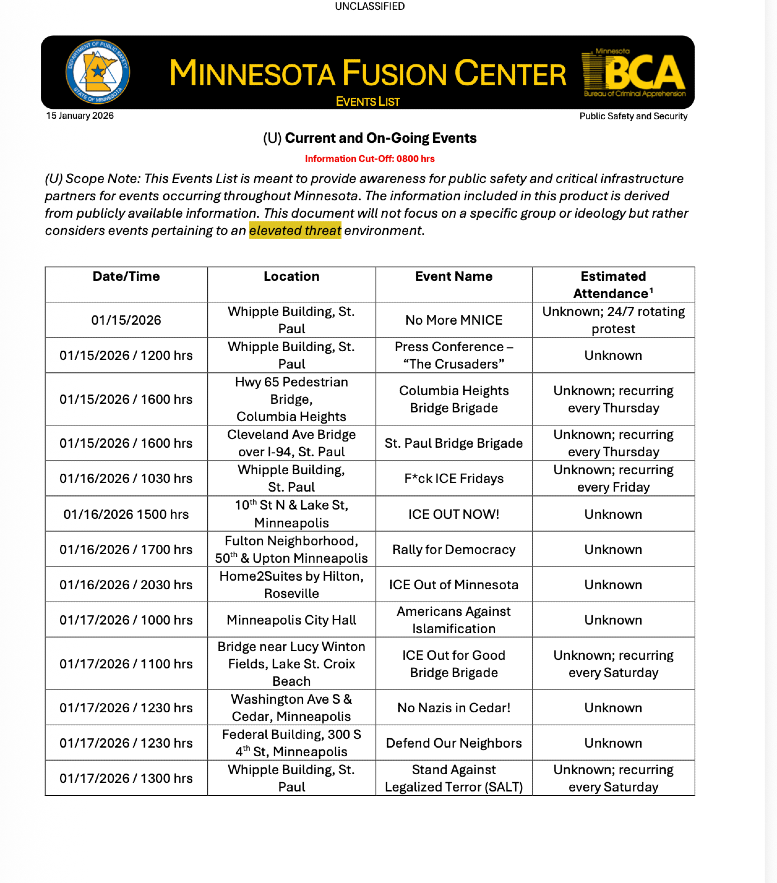
The reports tracked protest locations, demonstration names, estimated crowd sizes, scheduled demonstrations and vigils, and community gatherings. Across multiple reports, those details were organized under "events pertaining to an elevated threat environment," and included warnings of "an elevated risk of confrontations" between law enforcement, demonstrators, and legal observers.
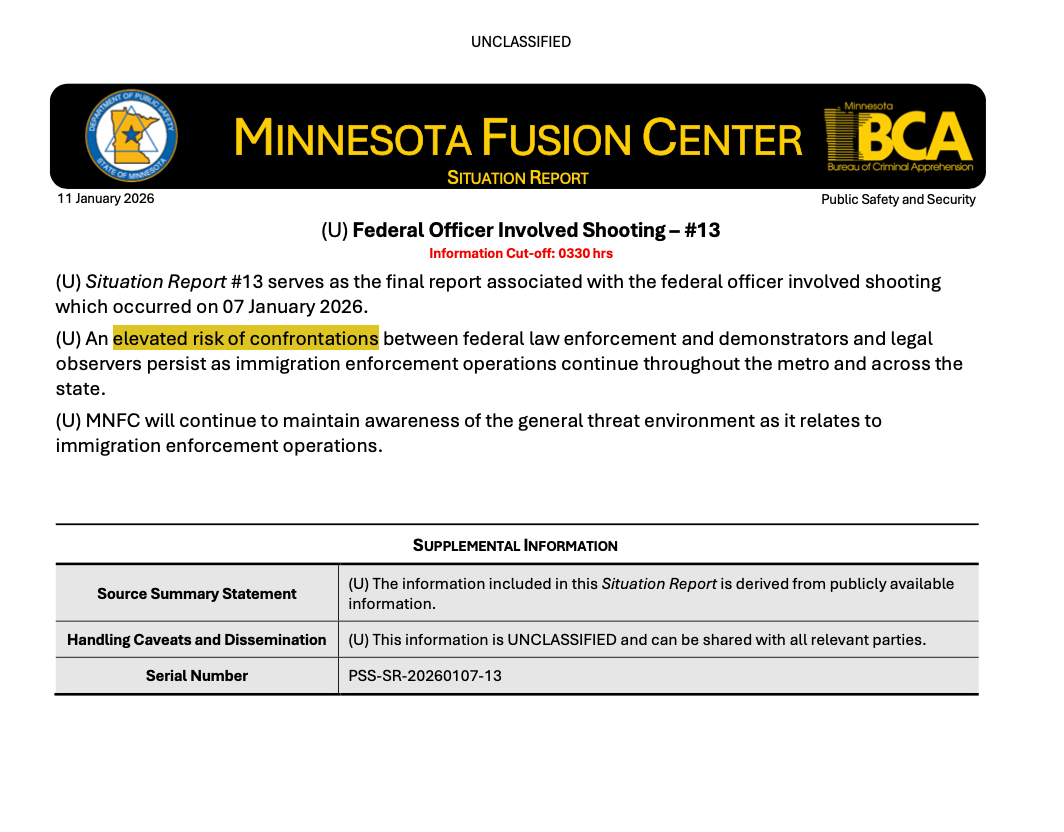
That framing matters. Protest activity did not have to be labeled “terrorism” in a JTTF agreement to become part of a threat-intelligence system. Once protest locations, crowd estimates, legal-observer presence, and neighborhood response to federal enforcement are treated as threat-environment information, they can be analyzed, retained, circulated, or made available to state and federal partners for use in future federal enforcement investigations or actions.
The risk is not only that protest activity was being closely monitored. It is that protest activity was converted into federal intelligence. A march, vigil, legal-observer presence, crowd estimate, or community response to ICE activity could become part of a record used to assess threats, allocate law-enforcement resources, justify police response, identify people or groups, or support future investigations under broad federal threat or domestic-extremism frameworks.
HSTF Turned Local Officer Time Into Federally Reimbursed Capacity
The Fusion Center records show how protest and community response moved through threat-intelligence channels. The Homeland Security Task Force agreement shows another part of the same federalization structure: money.
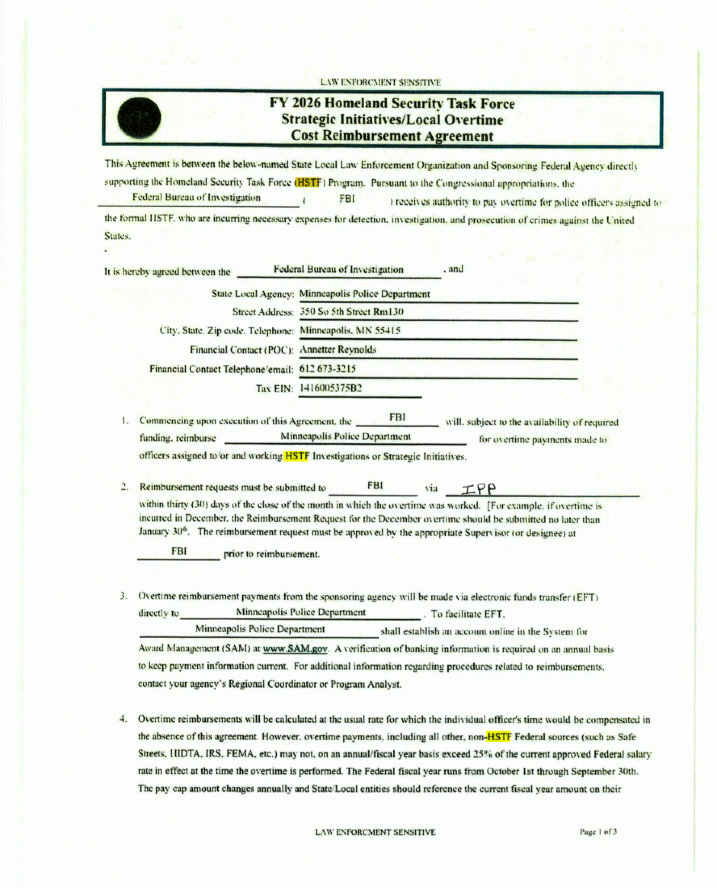
The HSTF agreement did not only make local officers available to federal enforcement systems. It created a reimbursement pathway for local officer time and overtime tied to federal investigations and “strategic initiatives,” allowing officers paid by Minneapolis taxpayers to be deployed toward federal priorities without public review, local limits, or clear democratic control.
The 2025–26 Homeland Security Task Force agreement is a Strategic Initiatives/Local Overtime Cost Reimbursement Agreement between MPD and the FBI in support of the DOJ’s HSTF program. The agreement authorizes reimbursement for MPD officers assigned to or working HSTF investigations or “strategic initiatives.” It describes reimbursable work as expenses connected to the “detection, investigation, and prosecution of crimes against the United States.”
That phrase is broad. It does not say local violent crime. It does not exclude immigration enforcement. It does not create a Minneapolis-specific limitation. The scope is federal.
A related HSTF Case and Officer Participant Form sets reimbursement caps, including a $30,000 per-agency cap per HSTF investigation and a $60,000 cumulative cap per investigation unless a waiver is approved.
The records reviewed so far identify 64 MPD officers connected to HSTF participation. They do not show whether all 64 worked HSTF cases, how many hours were billed, how much reimbursement was approved, or which investigations or “strategic initiatives” they supported.
But the scale matters. In a department with roughly 600 available officers, 64 officers would represent about one in ten available MPD officers who could be tapped for federal roles at any time.
The reimbursement structure also sat on top of an already lucrative and politically fraught overtime system. MPD officers were already among the city employees most able to drastically increase pay through overtime and off-duty work.
Public reporting showed MPD overtime spending rose from $22.6 million in 2023 to $27 million in 2024 and $31 million in 2025, while the department was investigating possible overtime misuse.
The HSTF participant form added another financial incentive : up to $22,155.25 per officer in FY 2026 overtime payments from all federal entities for officers assisting HSTF investigations or strategic initiatives.
This shows how federal reimbursement can make local participation scalable. It can turn local officer hours, overtime capacity, and command attention into reimbursable support for federal priorities at the same time Minneapolis residents were being told the department lacked enough capacity to meet local needs.
JTTF and HSTF created two different mechanisms of federalization. JTTF placed Minneapolis officers inside FBI-controlled task-force systems involving deputation, federal supervision, disclosure restrictions, body-camera rules, and federal records control. HSTF created a federal payment-incentive pathway for local officer time tied to broad federal investigations and strategic initiatives.
HSTF also cannot be separated from the federal campaign it sat inside.
In March 2025, then-Deputy Attorney General Todd Blanche issued a memorandum establishing Operation Take Back America. The memo described Homeland Security Task Forces as part of a broader federal initiative tied to immigration enforcement, cartels, transnational criminal organizations, human smuggling, trafficking, and violent crime. Under its first policy objective, the memo listed “Repelling The Invasion Of Illegal Immigration,” citing Executive Order 14159, “Protecting the American People Against Invasion.”
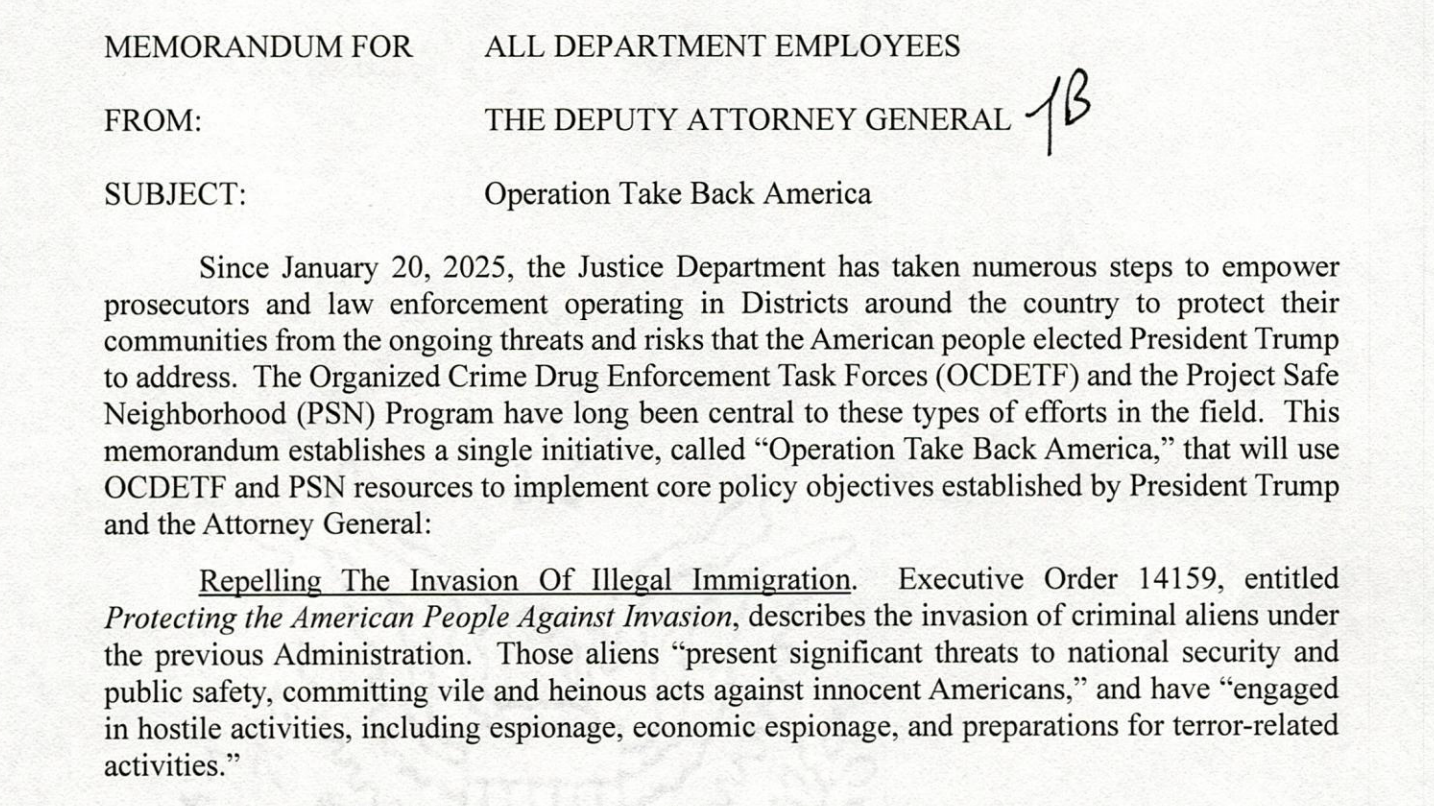
The HSTF agreement in MPD’s records does not have to say “immigration enforcement” on its face to raise serious concern. The federal program it supports was explicitly tied to immigration enforcement and shifting federal priorities.
That is the public-capacity problem. Minneapolis residents were told MPD was short-staffed. Internal records showed urgent calls waiting. Overtime was already gutting the city budget. Yet MPD entered an agreement that made local officer time and overtime reimbursable for federal investigations and strategic initiatives whose scope Minneapolis did not publicly limit.
Minneapolis Had Options. Other Cities Put Federal Task Forces Under Local Control.
None of this was inevitable.
Other cities have treated JTTF participation and federal task-force agreements as local-governance and civil-rights issues, not routine police paperwork. Some have withdrawn from JTTF participation. Others have required public reporting, council approval, civil-rights safeguards, or local-law compliance before police departments enter or renew federal agreements.
In 2017, Oakland required federal partnerships to remain consistent with state and local law, requiring annual public reporting to the Privacy Advisory Commission and City Council on federal task-force activity. Oakland’s ordinance also required proposed MOUs or amendments involving the JTTF or other federal task forces to go before the Privacy Advisory Commission for public discussion and comment before execution.
In 2019, Portland withdrew from the JTTF after public debate over civil-rights protections, immigrant rights, political surveillance, and whether city officials had enough oversight to ensure local officers followed local laws.
San Francisco also treated JTTF participation as a civil-rights issue. It entered a JTTF agreement after 9/11, but enacted civil-rights limits in 2015 after concerns about discriminatory policing and surveillance through the partnership.
Those cities show the point Frey and O’Hara avoided: federal task-force agreements are not merely operational documents. They decide who controls local officers, records, evidence, intelligence, body-camera footage, disclosure rules, and accountability when local police work inside federal systems.
Under Frey’s own MPD “reform” promises and the city’s court-enforceable obligations around transparency and accountability, he could have required public reporting, public review, City Council authorization, civil-rights safeguards, or ongoing oversight before MPD entered or renewed federal agreements.
Instead, under Frey’s command, MPD moved deeper into a federal policing system without the kinds of local limits and democratic accountability other cities have recognized as critical when local police authority is folded into federal authoritarian power.
Questions Frey’s Office Must Answer
Under the Minneapolis Charter, Mayor Jacob Frey cannot treat MPD’s federal agreements as detached from mayoral responsibility.
Minneapolis City Charter Article VII, § 7.3(a) gives the mayor “complete power over the establishment, maintenance, and command of the police department” and authority to make rules, regulations, and general or special orders necessary to operate the department. Frey’s own 2025 executive order on police reforms invoked that same charter authority.
MPD was also operating under binding reform obligations. The state MDHR agreement remained court-enforceable, requiring the City and MPD to make changes around lawful, non-discriminatory policing, supervision, accountability, transparency, data collection, and public trust. The federal consent decree had been dismissed after the Trump DOJ withdrew, but the City said Frey, MPD, and city leaders would continue implementing the federal reforms, request ELEFA monitoring, and share measurable proof of progress.
That means the unanswered questions are not only procedural. They go to the core of mayoral command, local control, public safety, civil rights, and MPD accountability.
Who controlled local police capacity?
Did Frey or MPD set limits on how many officers, overtime hours, vehicles, supervisors, records, or command resources could be used for JTTF, HSTF, federal help requests, protest response, or intelligence-sharing while Priority 1 calls were pending?
Who decided when MPD would respond, stand down, or assist federal agencies?
What written rules governed Watch Command decisions during Operation Metro Surge? Who decided whether MPD would respond to ICE-related protests, federal help requests, crowd situations, urgent 911 calls, or federal use-of-force incidents?
Who controlled local records, evidence, and body-camera footage?
If Minneapolis officers, MPD cameras, CAD entries, dispatch logs, incident reports, officer observations, or intelligence summaries became part of federal systems, what ensured that Minneapolis residents, state investigators, Hennepin County, oversight bodies, or the public could still access that information under Minnesota law and MPD policy?
What happened when federal agents killed, shot, or harmed people in Minneapolis?
What was MPD’s local responsibility when federal enforcement caused death or serious injury inside the city? Who secured scenes, preserved evidence, protected witnesses, supported Hennepin County or BCA investigators, notified city leadership, and documented decisions for later review?
How did Minneapolis prevent protest information from becoming federal threat intelligence?
What limits applied to Fusion Center, JTTF, HSTF, FBI, DHS, or ICE access to protest locations, aerial surveillance, legal-observer information, crowd estimates, dispatch data, body-camera footage, or other local public-safety records?
How did Frey’s office ensure MPD officers remained accountable to Minneapolis first?
When MPD officers worked inside federal task-force structures, which policies controlled: MPD policy, FBI policy, federal task-force rules, or all of them? Did Minneapolis separation policies apply? Did the court-enforceable MDHR agreement apply? Who reviewed alleged misconduct?
Who reviewed these agreements before O’Hara signed them?
Did Frey’s office know? Did Frey approve them, receive a briefing, or delegate authority? Did the City Attorney review them for legality, public-records implications, civil-rights risk, MPD policy, separation-policy conflicts, the court-enforceable MDHR agreement, or Frey’s public commitment to continue federal consent-decree reforms after the Trump DOJ withdrew?
What changes now?
Will Minneapolis suspend, renegotiate, or publicly limit MPD participation in JTTF, HSTF, Fusion Center, or related federal task-force work? Will the city require public reporting, City Council review, civil-rights safeguards, City Attorney sign-off, and after-action review before MPD enters or renews future federal agreements?
O’Hara is gone. But the mayoral failure that got Minneapolis here still remains.
Frey’s office owes Minneapolis a public account of who approved MPD’s deeper federal role, who monitored it, how residents were protected, and whether he will subject MPD’s federal role to public limits, enforceable oversight, and local accountability—or continue allowing MPD to move deeper into a militarized federal enforcement machinery that targets immigrant communities, obscures public records, weakens civil-rights protections, and makes Minneapolis residents less able to hold their own police department accountable.
O’Hara may have signed the agreements. But Frey commanded the department. The duty to limit, oversee, and account for that power is his.

Did you read this far?
Thank you for supporting this work—and for believing that public systems should be accountable to the people they serve.
Who am I?
I’m Molly Priesmeyer, a former investigative reporter and still-obsessive research nerd based in Minneapolis!
I now work as a systems-change strategist and Director of Narrative and Advocacy Strategy, which is mostly a fancier nonprofit-y way of saying I spend a lot of time researching, analyzing, synthesizing, obsessing over, and translating complex data, narratives, policies, power, and systems into something people can understand, use, and act on.
I also watch a lot of ER lately. And sniff lilacs and peonies. Speaking of peonies, you can find me on Bluesky as @mollypeonies.
What is this thing?
In January and February, I submitted extensive public-records requests to the Minneapolis Police Department under the Minnesota Government Data Practices Act. My original goal was to gather documents and source material that could help reporters, advocates, researchers, and residents better understand federal enforcement activity, emergency response, public safety, and police accountability in Minneapolis.
The records I have received so far cover the period from December 1, 2025, through February 4, 2026. They include emails, incident reports, 911 transcripts, call-for-service data, internal communications, emergency-response records, staffing and deployment materials, outside-agency communications, and federal-local law-enforcement agreements.
Together, they offer a partial but important view into how Mayor Jacob Frey and MPD leadership governed local police power as federal enforcement activity escalated across Minneapolis: how they planned, what they prioritized, how they made command decisions, and what protections they did—or did not—put in place for residents.
After reviewing thousands of pages of records, I identified several issues that appeared significant and warranted public attention. When local reporters did not respond to some of those concerns, I decided to publish the documents and analysis myself so residents can see the records, understand the context, evaluate the questions they raise, and demand the transparency and accountability Minneapolis residents are owed.
I’m starting with the 2025 federal task-force agreements because they show how the structure was built—and how decisions made without clear local command, public limits, or enforceable safeguards could expose Minneapolis residents to harm. These agreements made local police labor, records, intelligence, evidence, overtime capacity, and command authority available to federalized law-enforcement systems at a moment of escalating federal power.
More reporting will follow in the coming weeks on what these records reveal about MPD command, federal enforcement activity, emergency-response delays, public-safety priorities, civil-rights protections, and why these documents matter far beyond Operation Metro Surge
Want to get involved?
If you spot a significant error, please message me! Accountability to truth, integrity, and each other is part of the collective work—and part of holding public systems to the same standard.
If you want to help with deeper-dive data analysis, message me! I can point people toward specific documents, questions, spreadsheets, timelines, and patterns that need closer review. Let's do this!
See you around Minneapolis, comrades!