About That Star Tribune Retraction: What Wisconsin DNR Records Show About How the Story Unraveled
This is not another story about the Julie Nelson boat crash. (You're welcome.)
It's about what happened after the Star Tribune published its story about the boat crash: How the article was challenged, how quickly it disappeared, why the paper issued a full retraction, and what Wisconsin DNR records reveal about the failure behind it.
Last week, the Minnesota Star Tribune fully retracted a June 22 article by reporter Paul Walsh about a boat crash on Wisconsin’s Balsam Lake involving KARE 11 anchor Julie Nelson and her husband, Kurt Krumenauer. (Archive of the original story is here.)
The retraction said the article did not meet the paper’s standards for accuracy, verification, and editorial rigor. The "article," it said, incorrectly attributed a quote to Matthew Pierce, a Wisconsin DNR records coordinator, and inaccurately paraphrased a DNR spokesperson in a way that made it appear she had commented on the incident when she had not.
That explained what the Star Tribune was admitting.
It did not fully explain how the retraction came to be.
Where did the errors originate? Who brought the problem to the Star Tribune’s attention? Who, if anyone, asked the paper to correct, remove, or retract the story? And what do the available records show — or fail to show — about the Star Tribune’s correction and retraction process when a story contains errors serious enough to create potential legal exposure?
Those were the questions I wanted the records to answer.
So I sent my own public-records request to Wisconsin DNR.
Paul Walsh sent two weird data requests to the Wisconsin DNR. Then he quoted himself in an article about the accident.
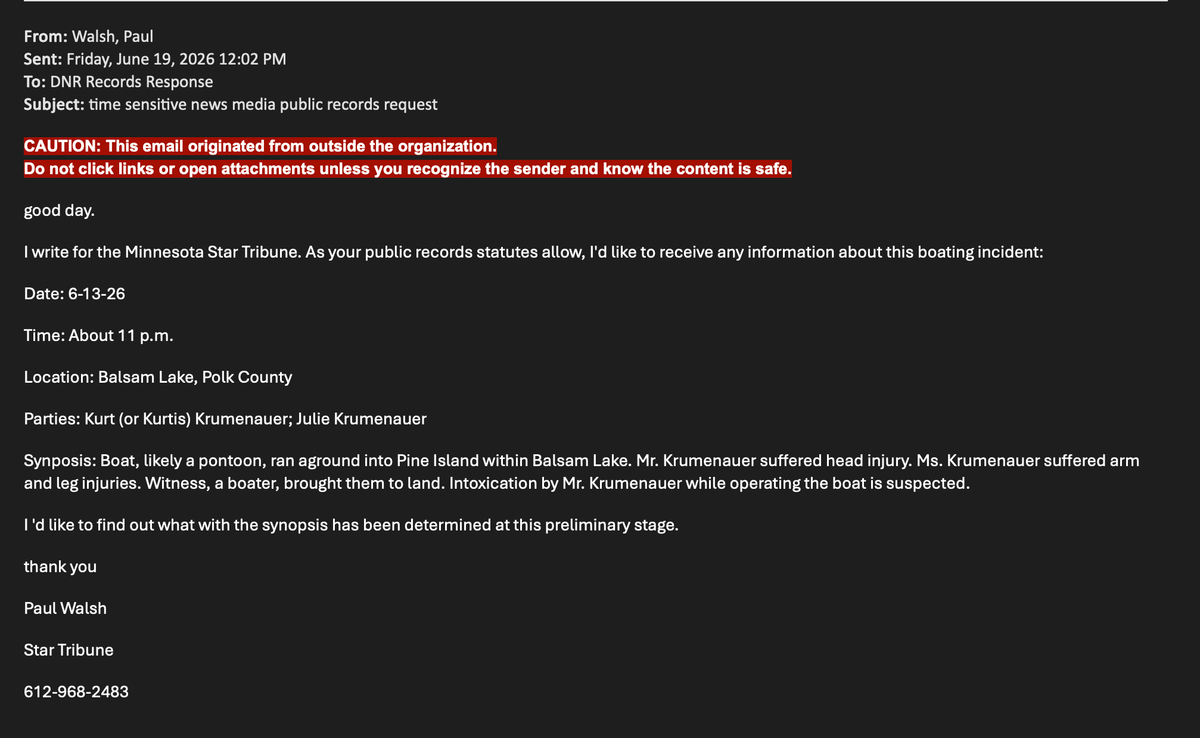
Email records show that on Friday, June 19, Walsh emailed Wisconsin DNR’s general records address with what he described as a “time sensitive news media public records request.”
He did not simply ask for records. He wrote his own detailed synopsis of the incident:
“Synposis [sic]: Boat, likely a pontoon, ran aground into Pine Island within Balsam Lake. Mr. Krumenauer suffered head injury. Ms. Krumenauer suffered arm and leg injuries. Witness, a boater, brought them to land. Intoxication by Mr. Krumenauer while operating the boat is suspected.
I’d like to find out what with the [sic] synopsis has been determined at this preliminary stage.”
The email records show that some basic information about the crash was already circulating among reporters before Walsh’s June 19 records request. In a separate inquiry to the Wisconsin DNR on June 18, Pioneer Press reporter Mary Divine wrote that she understood from the Polk County Sheriff’s Office that DNR was handling the accident report, and she described a pontoon crash on Balsam Lake involving Kurt Krumenauer and Julie Nelson.
Three days later, on June 22, Pierce responded to Walsh's email. He quoted Walsh’s request back to him — including Walsh’s own synopsis — and placed DNR’s response underneath.
Pierce's response below said the Wisconsin DNR had located responsive records but was “withholding them because they were part of an open and ongoing investigation.” He told Walsh his request was closed, told him he could submit a new request in two to three months, and wrote that DNR “does not comment further on active investigations.” (See full email below).
That quoted-request format is not unusual. After I submitted my own request to the Wisconsin DNR, I received the same kind of response: DNR quoted my request back to me and answered below it. The quotation marks did not mean DNR adopted or confirmed my language. They preserved my exact wording and identified the scope of the request being answered.
About 34 minutes after Pierce told Walsh that DNR would not comment further and had closed the request, Walsh followed up: “Once a case is forwarded to prosecutors for a charging decision, can you update me?”
Pierce replied: “Unfortunately we cannot provide such updates. We do not have the resources or ability to keep track of open investigations / closed requests. Ultimately, each requester is responsible for submitting new requests, which is why we provide a general timeframe to consider. For example, if you submit another request in two months, we will at that time confirm the case status with the investigating wardens and proceed from there.”
Other reporters checked the Star Tribune’s claims
After the Star Tribune story was published on June 22, other newsrooms contacted DNR to verify what the article appeared to attribute to agency staff.
At 5:56 p.m., Matt Kummer of KARE 11 emailed Pierce and Joanne Haas, a Wisconsin DNR public information officer and former reporter, with the Star Tribune story and asked whether the information attributed to DNR was accurate.
Haas responded at 7:16 p.m.: “No, Matt, this is not accurate.” She wrote that neither she nor Pierce had said DNR was investigating the crash ahead of a decision about potential charges involving a specific person, and that Pierce “did not say what is quoted to him.”
At 6:36 p.m., Kristi Miller of the Pioneer Press asked Haas whether she had really said DNR was investigating the crash “ahead of a decision about potential charges.” Haas again said she had not.
Around 7:40 p.m., Adam Uren of Bring Me The News contacted DNR after seeing the Star Tribune report that alcohol use was being investigated “based on information provided by the Wisconsin DNR.” He asked whether DNR could confirm that reporting.
DNR’s answer was no.
DNR escalated the issue to Star Tribune editors
That evening, Haas went to Star Tribune leadership.
At 8:44 p.m., she sent an email with the subject line "Paul Walsh" to several Star Tribune editors and leaders, including Maria Reeve, Tom Buckingham, Kyndell Harkness, Andy Putz, the general editor address, and Eric Wieffering, the paper’s managing editor and vice president.
Haas said she was using a "big blanket approach" because she was not sure which leader should receive a message about "a story with serious errors."
Then she wrote: "Paul Walsh is not a reporter."
Haas also said she had "stupidly thought he was new to reporting and new to police activities," which is why she tried to explain that the investigation was "nothing out of the ordinary."
Internally with DNR staff, she made the same point more plainly: Walsh’s question about "what kind of investigation" made her think he "must be new to reporting or police beats." After seeing how the story used her explanation, she wrote, "I feel like an idiot for trying to help him."
Haas told the Star Tribune editors she was not calling for Walsh’s dismissal, but said he "clearly needs mentoring and guidance to determine if reporting is really his calling."
Paul Walsh is not a new reporter. He has worked for the Star Tribune for more than three decades. A February 2026 profile of retired journalist Pamela Huey reported that her husband, Paul Walsh, began working for the Star Tribune in 1992.
At 9:11 p.m., Wieffering replied that he was looking into the matter and might not be able to fully respond until the next day. "In the meantime," he wrote, "we’ve taken the story off our home page." He asked Haas to clarify whether the serious errors were that she and Pierce had been misquoted, or whether there were factual errors as well.
Haas responded at 9:21 p.m. that the issue was both attribution and fact. Pierce’s email, she explained, quoted Walsh’s request language —"the synopsis that Walsh wrote to request the information and NOT what Pierce wrote."
By 9:30 p.m., Haas told DNR colleagues that Star Tribune editors had emailed her and said the story had been taken down. Later that night, she wrote internally that there had been a late-night meeting with another editor on the night crew and that the paper planned to craft a correction the next day.
The next morning, on June 23, Wieffering emailed Haas only one sentence and a link: “We have published this retraction.” The retraction appeared under the byline "Star Tribune staff."
What the records show — and what they do not
The DNR records show where the central attribution error began. The suspected-intoxication language came from Walsh’s own records request, not from Pierce.
They also show the Star Tribune’s first visible steps: Wieffering said the story had been taken off the homepage; DNR later recorded that editors said the story had been taken down; and the next day, Wieffering sent Haas the published retraction.
But the records do not answer every question.
On June 22 — the same day Walsh’s story was published and removed — the paper announced layoffs and buyouts for 24 union employees, primarily in the newsroom. MPR reported that the cuts included copy editors, news assistants, print designers, and team leaders. Jeff Day, a Star Tribune reporter and co-chair of the Star Tribune Guild, told MPR that team leaders oversee reporters, steer coverage, provide first-round edits, and are “experts in their field.”
That timing may seem like a tidy explanation. A shrinking newsroom, fewer editors, and a sloppy story that slipped through.
But Walsh's article was already in motion — reported, written, edited, queued for publication, or published — before those cuts could explain how the serious factual and attribution errors originated.
The cuts may help explain the institutional backdrop. They may even be relevant to the editing environment around the story. But they do not explain the larger accountability questions in numerous public-safety and crime stories, where official claims, police narratives, court records, or agency information were published, attributed, or framed in ways the Star Tribune later had to correct because they were wrong, overstated, or inadequately verified.
A pattern of errors in police-driven reporting
The Balsam Lake retraction also sits inside a record of Star Tribune corrections and public criticism involving Walsh-bylined public-safety stories.
Since 2020, publicly available Star Tribune corrections show at least 19 Walsh-bylined or co-bylined stories corrected or retracted. That number alone does not prove an unusual error rate for a reporter with Walsh’s volume of reporting. But the pattern is relevant because several corrections involve the same kind of reporting failure at issue in the Balsam Lake retraction: Official information in public-safety stories being published, attributed, or framed without adequate verification. And they often involves cops as main sources.
In a 2021 Walsh-bylined court story, he misidentified a judge and incorrectly attributed claims that a suspect was “too violent” to a Hennepin County prosecutor. In 2002, he incorrectly reported a man pleading guilty to a fatal drunk-driving case was driving with a suspended license.
In 2024, in a weird Walsh-bylined story about a man with a mannequin living on a billboard in South St. Paul, Walsh incorrectly attributed quotes and information that the police department did not release. In another that same year about a fentanyl “smuggling scheme,” he incorrectly claimed a second person was pleading guilty.
The most serious prior example is the 2021 Winston Boogie Smith correction. The Smith story, co-bylined by Walsh, initially identified Smith as a “murder suspect” after he was shot and killed by members of a U.S. Marshals task force. The Star Tribune finally added an editor’s note nearly a week later acknowledging that this was false, that the information came from law-enforcement scanner audio, and that the paper had not independently confirmed it before publication.
Walsh has also faced years of public criticism for using "sex" language in stories involving alleged sexual abuse, coercion, exploitation, violence, and crimes against minors.
In December 2024, Violence Free Minnesota criticized the Star Tribune for publishing what it called “irresponsible, inaccurate, and damaging” language in a Walsh-bylined story involving alleged child sexual abuse. In January 2025, the Minnesota Coalition Against Sexual Assault made the same point directly involving another Walsh story: The issue was “not sex, a relationship, or a romance.” It was abuse and sexual violence.
When DNR said Walsh had falsely attributed information to public officials, the Star Tribune acted quickly, removing the story and issuing a full retraction. When community members and advocates said Walsh’s language minimized sexual violence, I found no comparable public correction, editor’s note, retraction, or standards explanation attached to the criticized stories.
So the question is not only how this one story failed to meet any and every standard.
It is what the Star Tribune treats as a correction-worthy failure — and what it leaves lingering uncorrected, unverified, and publicly unresolved, especially when the disputed reporting reinforces law-enforcement narratives, minimizes sexual violence, or shapes public understanding of people who are accused, harmed, killed, or otherwise unable to correct the record themselves.